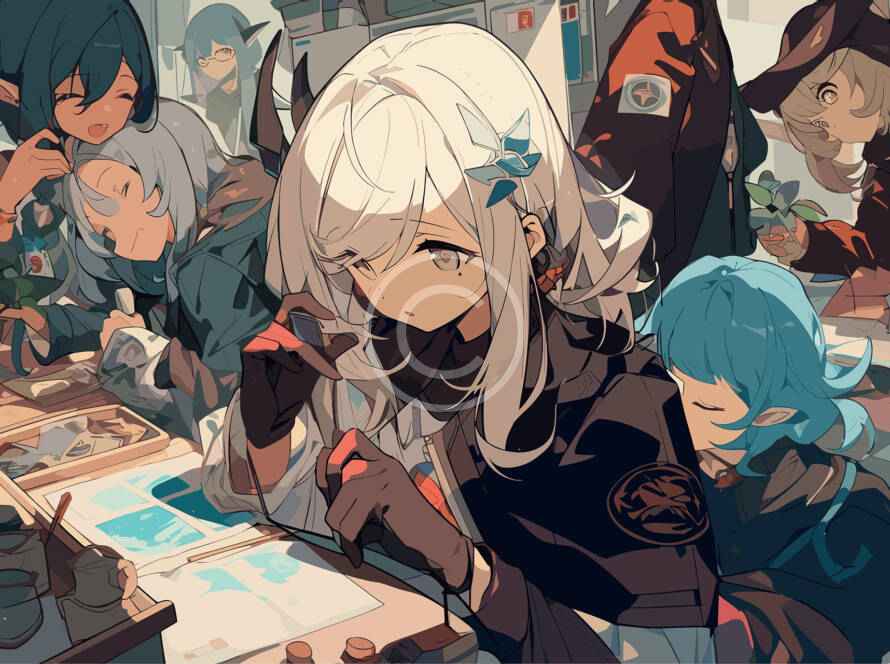


Effective worldbuilding is more than just drawing a map or inventing a language; it is the process of creating a cohesive reality where every element—from the political landscape to the individual powers of its inhabitants—feels earned and interconnected. The Cypress series serves as an example in this discipline, weaving a narrative that balances high-concept sci-fi with intimate psychological drama.
The Foundation: History Born from Conflict
In the Cypress universe, the world is defined by a history of survival and exploitation. The overarching conflict stems from the Syndicate, a mercenary army that fled a war-torn planet engulfed by an airborne virus. This group acts in a very direct and brutal way because they know the stakes at hand, but the world around them doesn’t necessarily align with their approach. This backstory provides immediate stakes: the Syndicate didn’t just appear; they were refugees who took the opportunity to overthrow a global government under the guise of protection.
We then need to blend black and white. The Syndicate are not really “bad guys,” their actions were originally born from a desperate need for survival after their own planet was decimated by a war-torn environment and a lethal airborne virus. While they eventually became an oppressive force on Earth, infiltrating global political spectrums to maintain control, their leader initially viewed himself as a savior for those who could not protect themselves. His motivations were driven by the trauma of watching his own world collapse, leading him to form the “Syndication” as a necessary shield against “alien scum,” even if that shield eventually became a cage for the people of Elysium. This complexity suggests that they are less like traditional villains and more like a cautionary tale of how protective instincts can evolve into parasitic tyranny when fueled by the fear of past devastation.
Building a world requires a clear sense of how the past informs the present:
- The Catalyst: A global pandemic and an alien DNA interaction that decimated an entire civilization.
- The Evolution: The Syndicate infiltrated political spectrums globally, transforming from protectors into parasites who control resources and dissent.
- The Result: A society built on the fear of past devastation, allowing a militarized organization to rule with an iron fist.
But the more important aspect of this whole ordeal is the fact the Syndicate are just an ongoing threat for the world of Cypress. While their political ties and motivation deepen as the story progresses, the real conflicts Cypress deals with are simply compounded by the fact the Syndicate exists.
Contrast as a Narrative Tool: Elysium and the Underground
One of the most striking aspects of the worldbuilding in Cypress is the visual and social contrast within its primary setting, the sprawling metropolis of Elysium. Inspired by neo-Tokyo aesthetics, Elysium uses light and shadow to represent social stratification:
- The Heights: Towering skyscrapers bathed in neon lights that “kiss the sky”. The rich, powerful, people live here, out of grasp by the real world.
- The Depths: Bunker-style housing beneath the streets where the impoverished reside in “color washed” darkness. Things change the very second you cross the line to an entirely different lifestyle.
- The Buffer: Criminal gangs and automated transportation networks that bridge the gap between the two worlds.
By creating these physical tiers, the story naturally explores themes of power and control without needing heavy exposition. The world itself creates both heroes and villains all on its own by creating stories within itself.
Atmosphere and Sensory Worldbuilding
Finally, the world of Cypress is brought to life through sensory details that emphasize its “dark world” aesthetic.
- Visual Motifs: The “omen grey and black armor” of Syndicate soldiers and their reflective visors serve as a chilling reminder of constant surveillance.
- Technological Decay: The transition from traditional subways to automated taxi stands reflects a world moving too fast for its people, leaving behind “labyrinthine tunnels” filled with those hiding from the light.
- Emotional Resonance: The silence of a neon-lit rooftop or the “musty smell” of a forgotten station adds a layer of grime and reality to the superhero genre.
Integrated Character Design: Powers with Purpose
Worldbuilding extends to the characters themselves. In Cypress, superhuman abilities are not random; they are the result of specific scientific experimentation or anomalous births tied to the world’s history.
| Archetype | Origin of Power | Narrative Function |
|---|---|---|
| Shadow | Half-human/half-alien experiment. | Represents the traumatic physical cost of Syndicate experiments. |
| Sheffler | Syndicate-engineered strength. | Provides a grounding, loyal presence against the isolation of heroism. The strong arm to rest on. |
| Cypress | Magical powers granted via prenatal treatment. | Her illusion-based abilities mirror her internal struggle with isolation and self-doubt, and sometimes feeling invisible. |
Cypress’s ability to manipulate perception—summoning blue energy or hallucinogenic dust—is a direct reflection of her role as an espionage agent and her own fractured sense of reality. Her powers require her to confront the “deepest fears” of others, which mirrors the “whispers of doubt” she fights within herself. She is able to vanish right in front of everybody, and this resembles how she sees herself in the world.
Sheffler has simplistic powers of strength, and looks big in every panel he appears in. This is to resemble his ability to be the person Cypress (and Shadow) can fall back on when they need him. He’s always stable and ready to carry the team.
Conclusion
Crafting a landscape as intricate as Cypress demands an commitment to internal logic. Whether it is the granular molecular regeneration of an antagonist like Nocturne or the generational trauma born from political upheaval, every detail anchors the narrative to its core theme: even within a world defined by systemic shadow and absolute control, the deliberate actions of the few can serve as a vital beacon of hope.
Every character, action, and even the buildings themselves are telling a story. Nothing is placed in the world just to look cool or make a panel pretty, it’s all crafted around building something larger than itself.